
Minimum Good, Maximum Bad
Still trying to convince yourself the good outweighs the bad?

When I sit down with someone who’s burned out, the conversation often becomes a math equation: they’re trying to convince themselves that the good still outweighs the bad.
At any given time, many people are running a mental scale. On one side are all the Good Things: the mission, the team, the compensation, the relationships, the work they’re proud of. On the other sits the Bad Things: a board that doesn’t have their back, a culture that’s turned toxic, a workload that never lets up, the creeping feeling that nothing they do is ever enough.
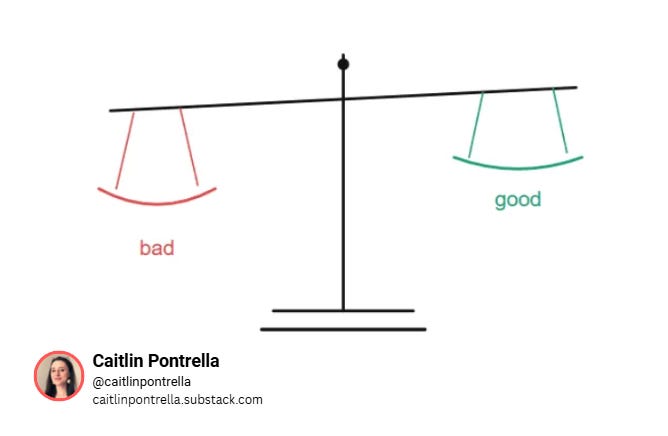
They keep adjusting the balance, trying to find more good things or ‘reframe’ the bad things to lighten the weight, hoping that if they just get the math right, the scales will finally settle somewhere that feels okay. That they’ll feel a little less burned out.
But they never do… because that’s the wrong model.
When it comes to your happiness at work (or the project you’re working on, or the relationship you’re in, etc) good and bad aren’t weights you can balance against each other. At a certain point, no amount of good can cancel out the bad.
Because good and bad aren’t a scale. They’re a floor and a ceiling. They are two separate thresholds that operate independently of one another. And once you see that, you’ll realize the balancing act you’ve been doing was never going to make you feel better.
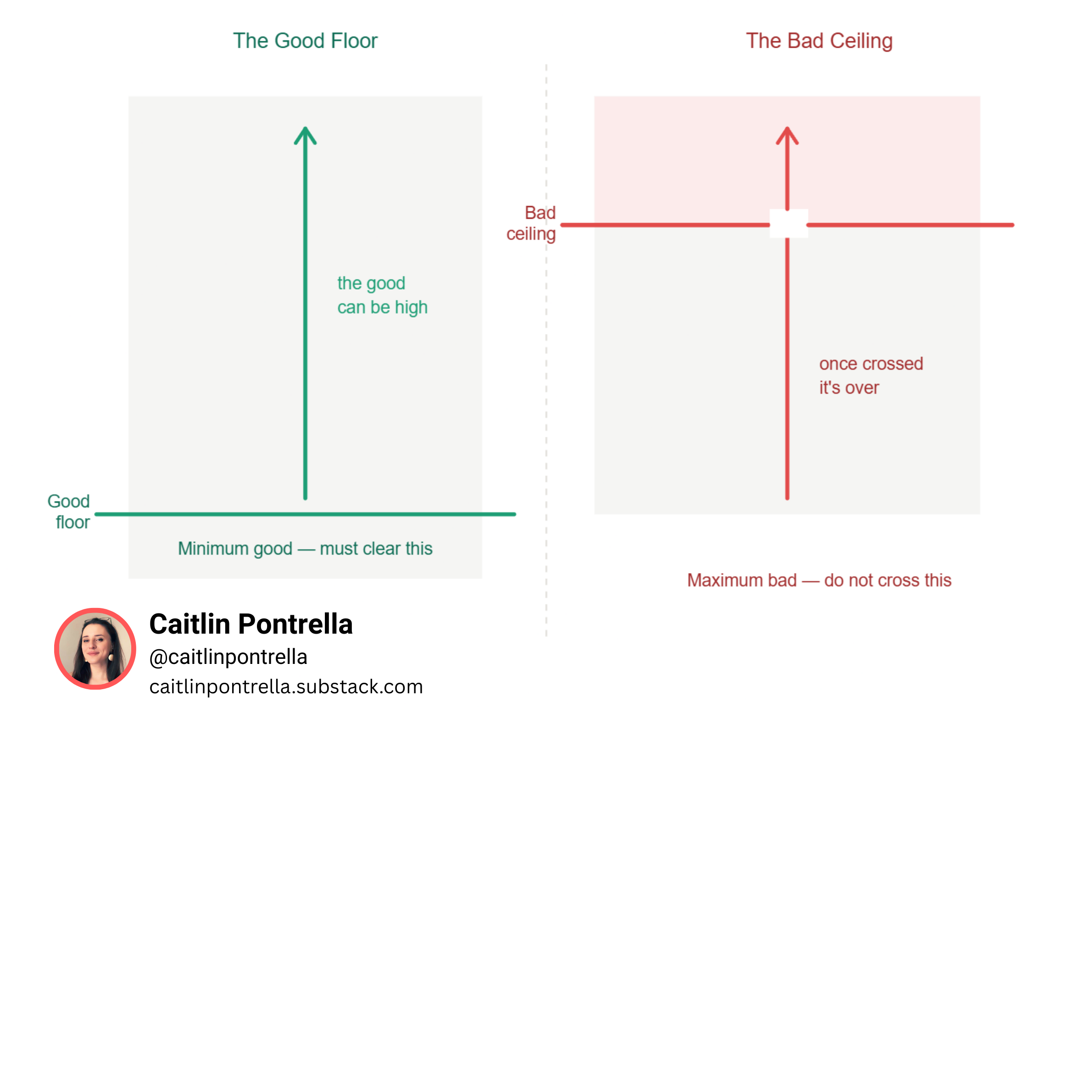
The Maximum Bad, Minimum Good Thresholds
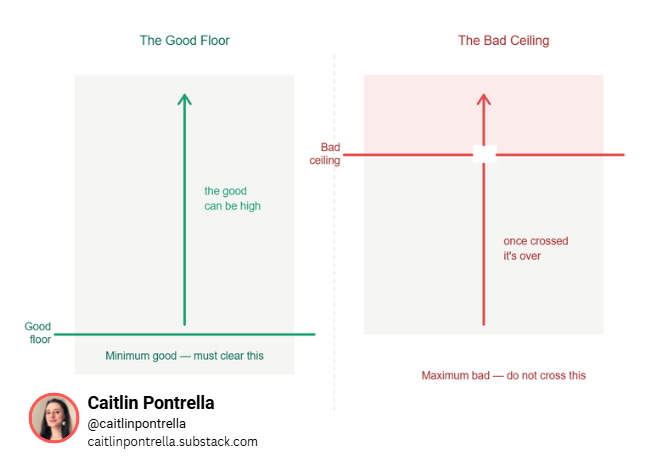
This is my Floor and Ceiling mental model.
When deciding whether to stay in a job, or continue a project, or remain in a relationship, you should have two separate thresholds:
A Minimum Good Floor
A Maximum Bad Ceiling
For something to be worth continuing, you need to be above the floor AND below the ceiling, at the same time, always.
The Good Floor.
First, your situation has to clear a floor. At work, that might mean the work needs to align with your passion or offer a certain salary or provide opportunities for travel or come with a kick ass team. In a relationship, it might mean respect, support, and feeling seen. Whatever your situation, these things are the bare minimums, and if what’s going on doesn’t meet or exceed these, you already have your answer. It’s a non-starter.
The Bad Ceiling.
There are also things that simply cannot be exceeded. Not balanced out, not justified, not waited out. I mean dealbreakers. At work, it might be a boss who undermines you, a culture that’s contrary to your values, boundaries that get crossed. In a relationship, you probably know your red flags, maybe the smoke or they don’t live in the same city as you. It’s different for everyone, but these are your non-negotiables. Once one of them is crossed, it’s over, full stop.
The Hard Part
That all seems straightforward enough. Problem is, people don’t feel things in such a black-and-white way.
You will find yourself one day in a position where the good is genuinely, undeniably good. The mission lights you up or the team is the best you’ve ever worked with or the work is some of the most meaningful you’ve done. And then something crosses your bad ceiling. And suddenly you’re facing the most disorienting version of this problem… because leaving doesn’t feel logical. You’re walking away from something that still feels, in a lot of ways, remarkable.
I don’t dismiss that. The good is real. Its value is real.
But Good can’t determine the outcome on its own. The two thresholds shouldn’t talk to each other. The ceiling doesn’t care how high the Good is. And if you choose to stay after your maximum Bad has been crossed, you’ve started a clock, waiting for the situation to correct itself. Asking the question again and again, running the math one more time.
But you already have your answer.
The ceiling doesn’t care how far above the floor the Good is. When the Bad Ceiling gets crossed, it’s crossed, No amount of good brings you back.
This is the moment your integrity and self-respect are most hard tested. Stop the project. End the Relationship. Quit the Job. Your happiness and health and your principles need to come first
The Expensive Miscalculation
It’s easy to brand suffering as perseverance. To tell yourself the sacrifice is admirable, that commitment means pushing through. Let me hold your hand when I say this: no. That’s an expensive miscalculation. The cost of staying past your Maximum Bad will show up in your decisions, in how you lead, in what you’re able to give the people who actually need you at your best. The damage rarely stays contained.
I never tell people to ‘look on the bright side’.
I ask: has something crossed your line? (Not a line you’re drawing in frustration, or a bad week or a hard quarter… but a genuine dealbreaker, something you knew mattered before it was tested.)
And most of the time, they already know. Maybe they’ve known for a while. They just needed a model that stopped asking them to keep doing the math.
When your maximum bad threshold is crossed, the answer is clear and simple.
Questions You Can Ask Yourself
Has something happened that I previously said was non-negotiable?
If a friend described this situation to me, would I tell them to stay?
Am I staying because the situation is healthy or because leaving feels hard?
What would have to change immediately for this to fall back below my ceiling?
If nothing changed for the next year, would I still choose to be here?
Final Thought
You need to know your floor and respect your ceiling. The good and the bad are not in conversation with each other. They don’t negotiate. Your floor tells you what you need to stay. Your ceiling tells you when it’s time to go. Know both. Honor both. That’s the whole model.